
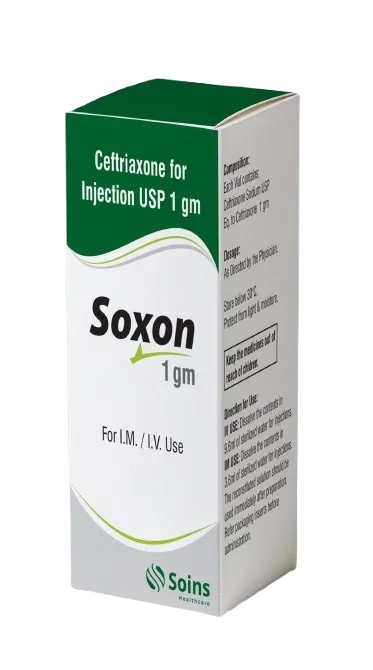
Soxon

Generic Name:
Soxon
Therapeutic Category:
Antibacterial / Third-Generation Cephalosporin
Mechanism of Action:
Bactericidal action. Inhibits bacterial cell wall synthesis by binding to one or more penicillin-binding proteins (PBPs), which breaks down the structural integrity of the cell wall and results in bacterial cell death.

Indications (Therapeutic Uses)

Ceftriaxone 1 gm is a broad-spectrum antibiotic indicated for the treatment of severe or complicated infections caused by susceptible organisms:

  • Lower Respiratory Tract Infections: Severe community-acquired pneumonia and hospital-acquired pneumonia.
  • Acute Bacterial Otitis Media: Treatment of severe middle ear infections when oral therapy is failing.
  • Skin and Skin Structure Infections: Serious complicated wound infections, cellulitis, and soft tissue abscesses.
  • Urinary Tract Infections (UTIs): Complicated and uncomplicated urinary tract infections, including pyelonephritis (kidney infection).
  • Pelvic Inflammatory Disease (PID) & Gonorrhea: Treatment of acute, uncomplicated sexually transmitted infections caused by Neisseria gonorrhoeae.
  • Bacterial Sepsis / Septicemia: Severe bloodstream infections caused by both Gram-negative and Gram-positive pathogens.
  • Intra-Abdominal Infections: Peritonitis and biliary tract infections, often combined with an anaerobic agent.
  • Meningitis: Treatment of bacterial meningitis due to its excellent ability to cross the blood-brain barrier.
  • Surgical Prophylaxis: Preoperative administration (typically 30 to 120 minutes before incision) to reduce the risk of post-surgery site infections.

Dosage & Administration

Website Note: Dosage, reconstruction method, and administration rate must be carefully calculated by a registered medical practitioner based on the patient’s age, infection site, and clinical severity.

  • Standard Adult Dose: Typically 1 gm to 2 gm administered once daily (or in equally divided doses twice daily), depending on the type and severity of the infection. The total daily dose should not exceed 4 gm.
  • Administration Routes:
    • Intramuscular (IM): Reconstituted with a proper diluent (such as Sterile Water for Injection or 1% Lidocaine Hydrochloride solution to reduce injection pain). It must be injected deep into a large muscle mass like the gluteus or vastus lateralis.
    • Intravenous (IV): Reconstituted with a compatible IV fluid (like 0.9% NaCl or 5% Dextrose) and administered via slow direct IV injection over 2 to 4 minutes, or as an intermittent IV infusion over 30 minutes.
  • Calcium Interaction Warning: Never mix or administer ceftriaxone concurrently with calcium-containing IV solutions (e.g., Ringer’s injection or Hartmann’s solution), even via different infusion lines, due to the critical risk of particle precipitation.

Contraindications & Precautions

  • Absolute Contraindications: Do not use in patients with a history of severe hypersensitivity (e.g., anaphylaxis) to ceftriaxone, any other cephalosporin antibiotic, or penicillins (due to potential cross-reactivity).
  • Neonatal Contraindications: Completely contraindicated in hyperbilirubinemic neonates and premature newborns. Ceftriaxone can displace bilirubin from albumin-binding sites, increasing the risk of bilirubin encephalopathy (kernicterus). Do not co-administer with calcium-containing solutions in neonates due to the risk of fatal crystalline precipitates in the lungs and kidneys.
  • Clostridium difficile-Associated Diarrhea (CDAD): Broad-spectrum antibiotic use alters the normal colon flora, which can lead to C. difficile overgrowth. Mild diarrhea to fatal pseudomembranous colitis can occur.
  • Biliary Pseudolithiasis (Gallbladder Sludge): High doses of ceftriaxone can cause precipitates of calcium-ceftriaxone in the gallbladder, appearing as shadows on ultrasounds that mimic gallstones. This is usually reversible upon drug discontinuation.

Potential Side Effects

  • Common / Mild: Pain, swelling, or induration (hardening) at the injection site; diarrhea, nausea, vomiting, rash, eosinophilia (elevation of a type of white blood cell), and transient increases in liver enzymes.
  • Less Common / Severe: Anaphylactic shock, severe C. difficile colitis, hemolytic anemia, neutropenia, acute renal failure, and severe cutaneous adverse reactions (such as Stevens-Johnson syndrome).