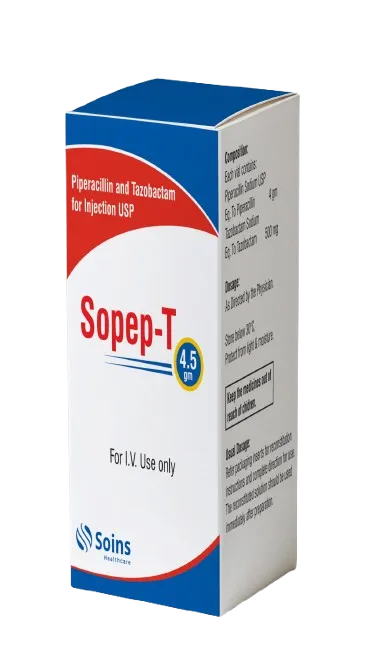
Sopep-T

Generic Name:
Sopep-T
Therapeutic Category:
Antibacterial / Extended-Spectrum $\beta$-lactam antibiotic + $\beta$-lactamase Inhibitor
Mechanism of Action:
Dual-action bactericidal effect. Piperacillin inhibits bacterial cell wall synthesis by binding to penicillin-binding proteins (PBPs), leading to cell lysis. Tazobactam is a potent $\beta$-lactamase inhibitor that irreversibly binds to and inactivates bacterial $\beta$-lactamase enzymes, preventing the destruction of piperacillin and extending its spectrum to cover highly resistant strains.

Indications (Therapeutic Uses)

This combination injection is indicated for the treatment of moderate-to-severe, systemic bacterial infections caused by piperacillin-resistant, $\beta$-lactamase-producing susceptible strains:

  • Intra-Abdominal Infections: Complicated appendicitis (with rupture or abscess) and peritonitis.
  • Nosocomial Pneumonia (Hospital-Acquired Pneumonia): Severe lower respiratory tract infections acquired in healthcare settings, often used in combination with an aminoglycoside.
  • Community-Acquired Pneumonia: Moderate-to-severe cases that fail standard first-line therapies.
  • Skin and Skin Structure Infections: Complicated infections including diabetic foot ulcers, cellulitis, and ischemic/ischemic-neuropathic infections.
  • Gynecological Infections: Postpartum endometritis and pelvic inflammatory disease (PID).
  • Empiric Therapy in Febrile Neutropenia: First-line management for immunocompromised patients presenting with fever and suspected bacterial infection.

Dosage & Administration

Website Note: Dosage, dilution, and rate of infusion must be individualized and calculated by a registered medical practitioner based on the patient’s body weight, site of infection, and renal function.

  • Standard Adult Dose: Typically 3.375 g or 4.5 g administered every 6 hours (totaling 13.5 g to 18.0 g per day). For nosocomial pneumonia, 4.5 g every 6 hours is standard.
  • Administration Route: Administered strictly via Intravenous (IV) Infusion. It must be reconstituted with a compatible diluent (such as 0.9% Sodium Chloride or Sterile Water) and infused slowly over 30 minutes, or as an extended infusion over 4 hours depending on the clinical protocol. Never administer via intramuscular (IM) or direct IV bolus injection.
  • Renal Impairment Dosing: Dosage reductions and extended dosing intervals are required for patients with a creatinine clearance less than 40 mL/min, as both drugs are primarily cleared via glomerular filtration.

Contraindications & Precautions

  • Absolute Contraindications: Do not use in patients with a history of severe hypersensitivity (e.g., anaphylaxis, Stevens-Johnson syndrome) to piperacillin, tazobactam, any other penicillin-class antibiotic, cephalosporins, or $\beta$-lactamase inhibitors.
  • Severe Cutaneous Adverse Reactions (SCAR): Serious skin reactions like toxic epidermal necrolysis, Stevens-Johnson syndrome, and DRESS syndrome can occur. Discontinue treatment immediately if a systemic skin rash develops.
  • Neurological Complications / Seizures: High doses, especially in patients with pre-existing renal impairment, can trigger neuromuscular excitability, muscle twitching, or convulsive seizures.
  • Bleeding Manifestations: Some patients may experience altered platelet aggregation and prolonged bleeding times. This is more common in patients with renal failure.
  • Clostridium difficile-Associated Diarrhea (CDAD): Treatment disrupts normal bowel flora, potentially leading to toxic C. difficile overgrowth. Mild diarrhea to fatal colitis can occur; monitor patients carefully.

Potential Side Effects

  • Common / Mild: Diarrhea, nausea, vomiting, constipation, headache, insomnia, rash, pruritus (itching), and localized phlebitis (pain or swelling) at the injection site.
  • Less Common / Severe: Anaphylactic shock, severe C. difficile colitis, seizures, leukopenia/neutropenia (abnormal drop in white blood cells during prolonged therapy), hemolytic anemia, and acute interstitial nephritis (kidney inflammation).