
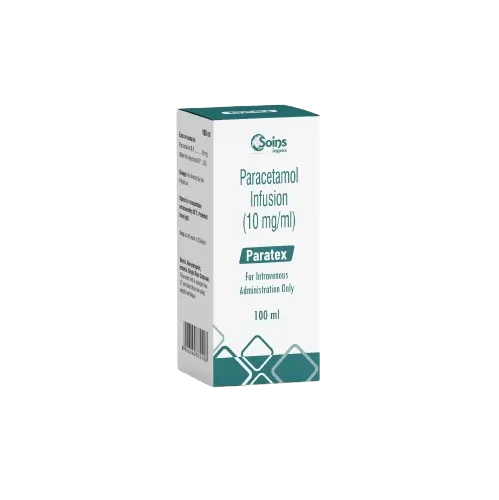
Paracetamol Infusion

Paracetamol Infusion

Generic Name:
Paracetamol Infusion
Therapeutic Category:
Central Analgesic / Antipyretic
Mechanism of Action:
Direct central nervous system activity. Paracetamol primarily acts by inhibiting prostaglandin synthesis in the brain, which elevates the pain threshold (analgesic effect). It interacts with the hypothalamic heat-regulating center to cause peripheral vasodilation and sweating, which rapidly reduces body temperature (antipyretic effect). When given intravenously, it bypasses first-pass hepatic metabolism, offering faster onset compared to oral forms.

Indications (Therapeutic Uses)

Paracetamol Infusion 10 mg/mL is indicated for the short-term treatment of pain and fever when oral or rectal routes of administration are clinically impractical or impossible:

  • Acute Post-Operative Pain: Management of mild-to-moderate pain immediately following surgical procedures, often serving as a critical component of multimodal, opioid-sparing pain relief protocols.
  • Severe Fever Management: Rapid reduction of high body temperature when urgent antipyretic intervention is required or the patient is unable to swallow.
  • Emergency Trauma Pain: Initial pain management in emergency care environments before definitive oral therapies can be established.

Dosage & Administration

Website Note: Dosage must be carefully calculated and administered strictly under the supervision of a registered medical practitioner. Prescription settings require precise weight-based calculation, particularly in pediatric and underweight patients, to completely eliminate the risk of life-threatening dosing errors.

  • Adults and Adolescents (Weighing more than 50 kg): The standard dose is 1,000 mg (one full 100 mL bottle) per administration. This may be given up to 4 times daily. The minimum interval between consecutive infusions must be at least 4 hours. The maximum daily dose must not exceed 4,000 mg (4 g) in 24 hours.
  • Adults and Children (Weighing between 33 kg and 50 kg): 15 mg/kg per administration. The maximum daily dose must not exceed 60 mg/kg or 3 g, whichever is lower.
  • Administration Method: Formulated as a clear, sterile, non-pyrogenic solution. It must be administered strictly via Intravenous (IV) Infusion over a duration of 15 minutes. It should not be given as an IV push or rapid injection.
  • Visual Inspection: Prior to administration, check the solution visually. It must be completely clear and free of particulate matter. Do not use if the solution is discolored or contains visible particles. It is intended for single-use only; any unused portion must be discarded immediately.

Contraindications & Precautions

  • Absolute Contraindications: Completely contraindicated in patients with a known history of severe hypersensitivity to paracetamol, propacetamol (its prodrug), or any of the inactive excipients. Strictly contraindicated in individuals suffering from severe hepatocellular insufficiency (severe liver failure) or active, uncompensated decompensated liver disease.
  • Fatal Dosing and Medication Errors: Severe care must be taken to avoid mixing up milligrams (mg) and milliliters (mL). Accidents involving calculating pediatric or low-weight adult doses have resulted in accidental, severe overdose leading to irreversible liver failure and death. Always verify the volume to be infused before starting.
  • Hepatotoxicity Risk: Paracetamol is metabolized primarily by the liver. An overdose can cause severe, acute liver failure requiring liver transplantation or resulting in death. Use with extreme caution in patients with mild-to-moderate hepatic impairment, chronic alcoholism, severe malnutrition, or total body dehydration.
  • Concomitant Paracetamol Use: Do not combine with other paracetamol-containing medications (such as oral cold/flu remedies or oral pain relievers). Double-dosing can quickly push total daily intake past safe thresholds, risking silent liver damage.
  • Antidote Management: In the event of an accidental overdose, the antidote N-acetylcysteine (NAC) must be administered intravenously or orally as soon as possible, ideally within 8 to 10 hours of the exposure, to protect the liver from toxic metabolites.

Potential Side Effects

  • Common / Mild: Pain or localized burning sensation at the injection site, mild dizziness, headache, nausea, vomiting, and transient constipation.
  • Less Common / Severe: Acute hepatotoxicity (elevated liver transaminases, acute liver failure), severe hypersensitivity reactions (anaphylaxis, angioedema), hypotension (sudden drop in blood pressure during rapid infusion), and rare but severe cutaneous reactions (such as Stevens-Johnson syndrome or toxic epidermal necrolysis).