
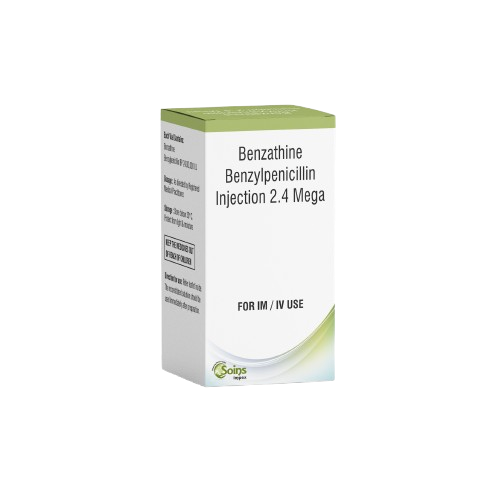
Benzathine Benzylpenicillin Injection

Benzathine

Generic Name:
Benzathine
Therapeutic Category:
Long-Acting Repository Antibacterial / Natural Penicillin (Beta-lactam)
Mechanism of Action:
Bactericidal action. It works by binding to specific penicillin-binding proteins (PBPs) inside the bacterial cell wall, inhibiting the final transpeptidation stage of peptidoglycan synthesis. This weakens the cell wall, causing osmotic instability, cell lysis, and death. Because it is chemically bound to benzathine, the drug dissolves very slowly from the injection site, providing sustained, low therapeutic blood levels for 2 to 4 weeks.

Indications (Therapeutic Uses)

Because it provides a steady, prolonged release rather than a high peak concentration, this injection is strictly indicated for treating or preventing chronic infections highly sensitive to low, steady levels of penicillin:

  • Syphilis:
    • Primary, Secondary, and Early Latent Syphilis: Recommended as a single-dose treatment to eradicate Treponema pallidum.
    • Late Latent or Latent Syphilis of Unknown Duration: Administered once weekly for 3 consecutive weeks (totaling 7.2 Mega IU).
  • Rheumatic Fever Prophylaxis (Prevention): Long-term secondary prevention of recurrent rheumatic fever by continuously suppressing Group A Beta-Hemolytic Streptococcal (Streptococcus pyogenes) upper respiratory infections.
  • Yaws, Pinta, and Bejel: Mass or individual treatment of endemic treponematoses.

Dosage & Administration

Website Note: This medication must be prepared and administered exclusively by a trained healthcare professional in a clinical setting equipped to handle severe allergic emergencies.

  • Standard Adult Dose (Early Syphilis): A single intramuscular injection of 2.4 Mega IU.
  • Standard Adult Dose (Late Latent Syphilis): 2.4 Mega IU via intramuscular injection once a week for 3 successive weeks.
  • Secondary Prevention of Rheumatic Fever: 1.2 Mega IU to 2.4 Mega IU administered intramuscularly once every 3 to 4 weeks, depending on clinical guidelines.
  • Critical Administration Protocol:
    • Strict Intramuscular (IM) Use Only: Must be injected deeply into the upper outer quadrant of the gluteus maximus (buttock) or the mid-lateral thigh.
    • Absolute Intravenous (IV) Prohibition: Never administer this drug intravenously. Direct IV injection can cause immediate, catastrophic vessel blockage, severe neurovascular damage, cardiac arrest, or death due to the thick, crystalline nature of the suspension.
    • Aspiration Rule: The clinician must aspirate the syringe before plunging to ensure the needle hasn’t accidentally entered a blood vessel. If blood appears, the needle must be withdrawn immediately and a new dose prepared.

Contraindications & Precautions

  • Absolute Contraindications: Strictly contraindicated in individuals with a verified history of immediate, severe hypersensitivity reactions (e.g., anaphylaxis, angioedema, Stevens-Johnson syndrome) to penicillin, benzathine, or any components of the vial.
  • Cephalosporin Cross-Sensitivity Risk: Use with extreme caution in patients who have a known allergy to cephalosporins or other beta-lactam antibiotics. Cross-reactivity occurs in approximately 5% to 10% of cases and can trigger life-threatening systemic reactions.
  • Jarisch-Herxheimer Reaction: Patients being treated for syphilis must be warned about this reaction, which frequently occurs within 2 to 12 hours after the first injection. It is triggered by the rapid release of endotoxin-like substances from dying spirochetes (Treponema pallidum). Symptoms include high fever, chills, sweating, muscle aches, headache, and temporary worsening of syphilitic skin lesions. It is generally self-limiting and managed with supportive care (antipyretics) but can trigger premature labor in pregnant patients.
  • Accidental Intravascular Injection Syndrome (Hoigné’s Syndrome): Severe, terrifying pseudo-allergic symptoms (fear of imminent death, visual or auditory hallucinations, confusion, tachycardia, seizures) can occur immediately if a small amount of the crystalline suspension accidentally enters a vein or artery during an IM injection, causing microscopic emboli.
  • Severe Local Injection Site Reactions: Due to the large, dense volume of a 2.4 Mega dose, significant localized pain, swelling, nodules, and bruising can occur at the injection site. Alternating injection locations is mandatory for multi-dose regimens.

Potential Side Effects

  • Common / Mild: Pain, tenderness, or a hard lump at the injection site, mild fever, nausea, dizziness, and mild skin rashes or hives.
  • Less Common / Severe: Immediate anaphylactic shock, the Jarisch-Herxheimer reaction, severe neurovascular damage or tissue necrosis near the injection site (Nicolau syndrome), hemolytic anemia, and Clostridium difficile-associated pseudomembranous colitis.